
The cashier guide was refreshed by Elena Marsh on 8 November 2026. Deposit and cashout rows are separated, with unknown limits left to the account cashier.
A Wild Robin withdrawal should be planned around method thresholds, account review and provider processing. The cashier tables cover cards, bank transfer, MiFinity, Bitcoin, Litecoin and DOGE. The ordinary minimum deposit is £10, while Bitcoin deposit starts at £30.
The figures below were checked on 8 November 2026 and availability can differ by account. Check the current cashier, currency and verification state before paying. Keep the promotion, transaction and withdrawal references as separate records.
| Method | Deposit minimum and maximum | Deposit time |
| Visa / Mastercard | £10–£2,000 | Instant |
| Bank transfer | £10–£5,000 | 1–3 days |
| MiFinity | £10–£2,500 | Instant |
| Bitcoin | From £30; confirm maximum | Network processing after cashier approval |
| Litecoin | Confirm cashier | Network processing after cashier approval |
| DOGE | Confirm cashier | Network processing after cashier approval |
Use a method in the account holder’s name and inspect whether it supports the intended withdrawal route.
Check remaining wagering, identity review, method minimum and receiving details. Record the exact status and timestamp.
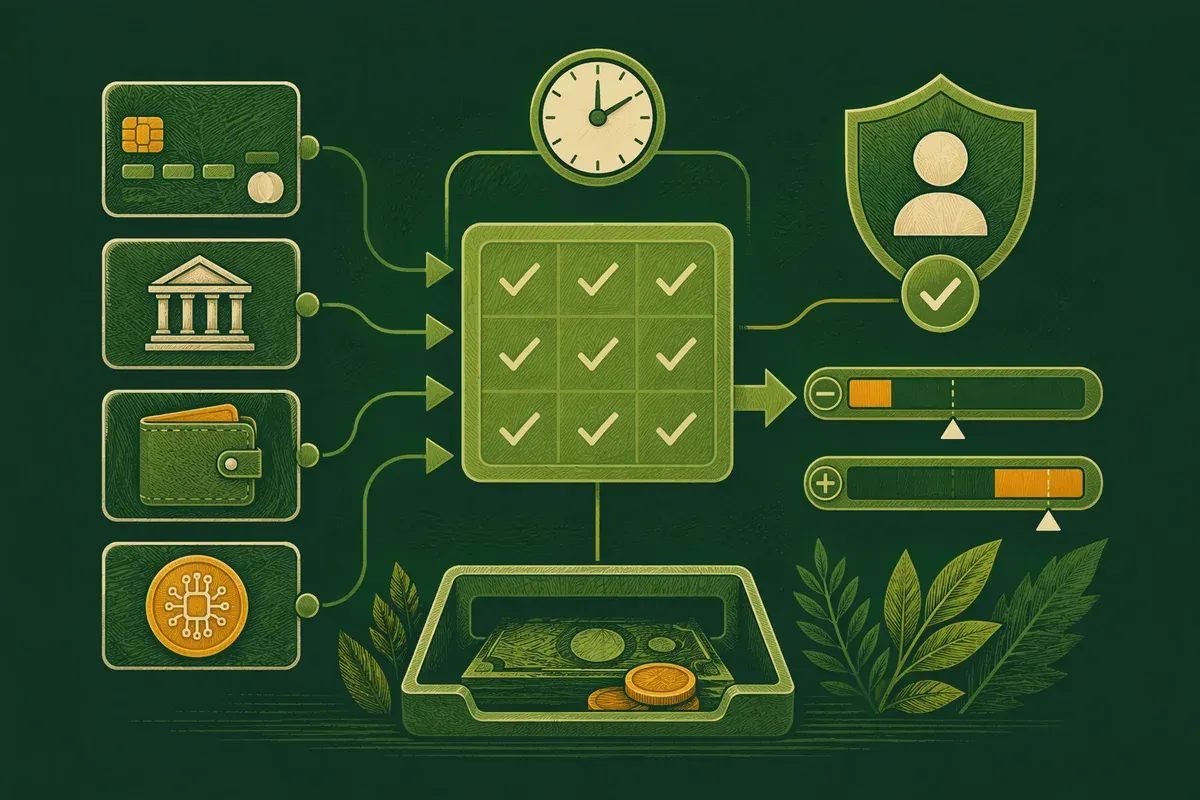
Every withdrawal route in one table: limits, time to arrive and the one thing to prepare before you press withdraw.
Fastest route to your money: MiFinity or crypto at 1–2 days. Smallest cashout: £10 by card, Litecoin or DOGE; Bitcoin starts at £60.
| Method | Cashout min–max | Arrives in | Before you request |
| Visa | £10–£3,000 | 1–3 days | Card in your name; never send the CVV |
| Mastercard | £10–£3,000 | 1–3 days | Card in your name; never send the CVV |
| Bank transfer | See cashier | 3–5 days | Account name must match your profile |
| MiFinity | See cashier | 1–2 days | Use the wallet you deposited from |
| Bitcoin | £60–£5,000 | 1–2 days | Check the address and network; keep the hash |
| Litecoin | £10–£5,000 | 1–2 days | Select the Litecoin network |
| DOGE | £10–£5,000 | 1–2 days | Select the Dogecoin network |
Card withdrawals are £10–£3,000 in one to three days. Bank transfers take three to five days, and MiFinity takes one to two days. Bitcoin withdrawals are £60–£5,000 in one to two days, while Litecoin and DOGE are £10–£5,000 over the same period.
A method timeframe does not necessarily include every account-check stage. Identify whether the request is awaiting documents, pending account processing, authorised or sent to the provider. Weekends, bank holidays, external wallet checks and network conditions can affect receipt.
| Method | Withdrawal minimum and maximum | Listed processing |
| Visa / Mastercard | £10–£3,000 | 1–3 days |
| Bank transfer | See cashier | 3–5 days |
| MiFinity | See cashier | 1–2 days |
| Bitcoin | £60–£5,000 | 1–2 days |
| Litecoin | £10–£5,000 | 1–2 days |
| DOGE | £10–£5,000 | 1–2 days |
Record request time, authorisation time and provider or network reference separately. This shows which party currently owns the next action.
Ask support which receiving route is permitted rather than cancelling and resubmitting repeatedly. Method changes can require additional ownership checks.
Crypto requires the correct asset, network and destination in addition to the cashier amount. Compare the address before confirming and account for external wallet or network charges. Keep the selected asset unchanged even when the same wallet displays several.
A transaction hash is useful only when a transaction has been broadcast. For a deposit that is not visible, check the wallet debit and network record before repeating it. For a withdrawal without a hash, ask whether account processing is still underway.
Provide the hash, asset, amount, timestamp and a safely truncated address. Never provide seed phrases, private keys or wallet passwords.
The deposit minimum is £30 and withdrawal minimum £60. These differ from the general £10 welcome minimum.
Identity, address and payment-ownership documents can be requested before account processing. Use registration details that match documents and a payment method belonging to the registered player. Third-party funding can complicate checks even when the transaction itself succeeded.
Upload clear files through the standard account route and retain the submission date. If a document is rejected, ask which field or image needs correction. Follow instructions for masking unrelated digits or transactions while keeping required identity and ownership fields visible.
Passwords, one-time codes, full card security codes and crypto private keys are not KYC documents.
Larger or unusual transactions can require financial documents. Ask which period and document types are needed and use only the authorised channel.
For a failed deposit, check whether the provider actually debited money. Record amount, time, method and exact message. If a debit exists without a cashier credit, support needs both provider and account references to trace it.
For a delayed withdrawal, name the current status rather than saying only that it is late. The external provider cannot trace a casino authorisation that has not occurred, and the casino cannot complete the provider’s own bank or wallet processing.
A refresh or slow response is not proof of failure. Inspect transaction history before trying again.
Use registered email, reference, amount, timestamp and status. Ask for one next action and the responsible processing stage.
No universal casino fee is asserted here. External providers, banks, exchanges and networks can apply their own charges or exchange rates. Compare the amount sent with the amount credited and retain both records when conversion occurs.
Set deposit limits before using the cashier and never borrow to play. A reward threshold, VIP message or pending withdrawal is not a reason to reverse a budget. Keep gambling money separate from bills and essential savings.
Keep essential expenses independent of a future cashout; account and provider stages can delay access.
Chasing losses, hiding transactions or using essential funds are warning signs. Use account controls and independent support.
A £20 card deposit fits the £10–£2,000 range and can meet the welcome minimum. A £20 Bitcoin deposit does not meet the £30 Bitcoin minimum. This distinction shows why the general promotion floor cannot replace the method row. The amount still needs to fit an affordable budget in either case.
For withdrawals, a £50 card request fits the £10–£3,000 range, while the same £50 request through Bitcoin falls below its £60 minimum. A £4,000 Bitcoin withdrawal fits the £60–£5,000 range, but still requires the correct address, network and any account checks. Range compliance is only the first checkpoint.
| Example | Range result | Remaining action |
| £20 card deposit | Fits card and welcome minimums | Confirm offer and ownership |
| £20 Bitcoin deposit | Below £30 Bitcoin minimum | Choose a valid affordable amount or method |
| £50 card withdrawal | Fits £10–£3,000 range | Check wagering, KYC and status |
| £50 Bitcoin withdrawal | Below £60 minimum | Check another permitted route or valid amount |
| £4,000 Bitcoin withdrawal | Fits £60–£5,000 range | Verify address, network and account checks |
Write the cashier amount and method, the provider amount and any conversion, and the final account or network reference. These lines reveal where a discrepancy occurred without storing sensitive credentials.
Record request status, authorisation status and provider receipt separately. If support asks for documents, add the submission timestamp instead of treating the original request time as the only relevant date.
Pause and keep the displayed range. Ask support whether the account, currency, verification or method route explains the difference. The current cashier determines which transaction is available.
Crypto and card routes have separate cashier ranges. Use the Bitcoin row in the matrix and confirm the current account cashier before requesting.
No. The listed card range is one to three days, separate from any account-check stage.
A hash is a public transaction reference, but private keys, seed phrases and passwords must never be shared.
Use methods belonging to the registered account holder; third-party funding can complicate ownership review.
